

Metrosud centres call for innovation and coordination in emergency services
Improving coordination between centres, optimising referral procedures and committing to innovation are the main conclusions of this first conference
All the participating centres are committed to offering quality emergency care and the conference is to become an annual event, whose venue will rotate
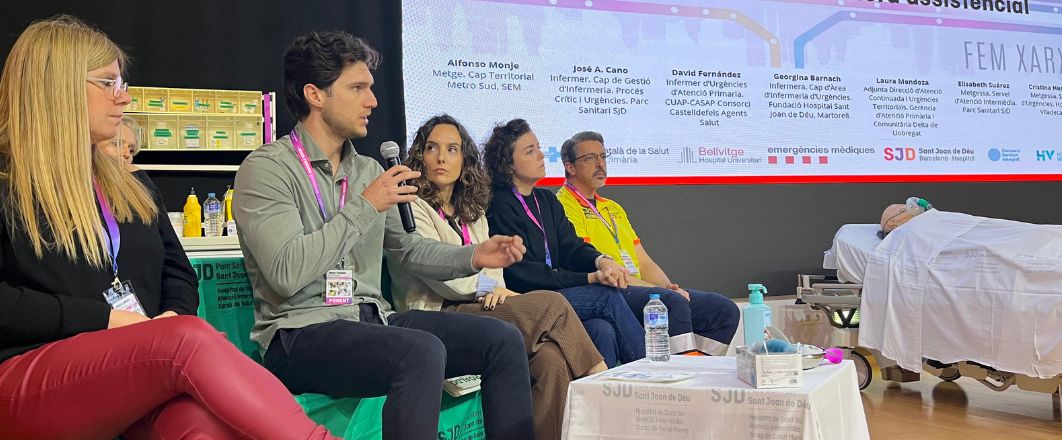
The event, which took place in the Parc Sanitari SJD auditorium, was attended by ten Catalan health centres and was jointly organised with the emergency services of hospitals in the area, Primary Healthcare and extra-hospital services
In-hospital and out-of-hospital emergencies in the Southern Metropolitan Region are constantly changing, with the complexity of care involved steadily increasing. This healthcare region serves more than 1,170,000 people annually.
To respond to today’s health challenges, such as increased fragility in elderly patients, chronic conditions and pressure on emergency services, healthcare professionals from different centres need a common space where they can share projects, exchange knowledge and discuss the current situation in order to improve referral procedures, introduce innovations in current care models and strengthen the network of professionals.
Parc Sanitari Sant Joan de Déu has organised the First South Metropolitan Region Emergency Conference with the support of local hospitals including Bellvitge University Hospital, Hospital Sant Joan de Déu Barcelona, Moisès Broggi Hospital in Sant Joan Despí and Viladecans Hospital; as well as the Medical Emergency System (SEM); and the Catalan Health Institute, with Primary Healthcare centres such as the CUAP in Castelldefels. The conference was also attended by representatives of the Hospital Sant Joan de Déu Foundation in Martorell, the Santa Creu i Sant Pau Hospital and the Hospital Clínic in Barcelona.
During the morning and afternoon sessions, more than 30 professionals from ten Catalan healthcare centres shared projects designed to meet some of the needs that Emergency services currently have in common. They referred to coordination between healthcare systems and levels, especially in urgent and critical processes; the difficulty of standardising procedures, especially in geographically diverse multidisciplinary environments; limitations in direct communication between professionals from different services and fields; the detection of complex and fragile cases, which require a transversal approach; and the efficient management of hospital resources.
According to Dr Luisa Villate, head of the Emergency Clinic at the SJD Sant Boi Hospital, “this conference is being organised at a time when healthcare is becoming increasingly complex. Demand continues to grow and patients are more fragile. This means we need to coordinate better, make referral procedures work more efficiently and invest in innovation. It is not an option, it is a necessity."
Improve, share and advance: the key to future Catalan emergency services
Emergency service specialists from three main fields presented projects for improving healthcare, exchanged knowledge and first-hand experiences and discussed the future and the scope for improving emergency services in this region. "The future of emergency departments will not come from a single centre, but will be developed by combining efforts, sharing knowledge and moving forward together towards a shared vision that puts people at the centre," explained Laura Fernández, head of the Emergency Department at the Sant Joan de Déu Hospital in Sant Boi.
In the inaugural lecture, Dr Ernest Bragulat, head of the Hospital Clínic Emergency Service in Barcelona, spoke about how emergency services have changed over the years. Dr Bragulat explained how patient numbers and their changing profile call for new care, management and leadership models in the healthcare system, centred on strengthening institutional coordination. “Two-thirds of patients presenting at the Emergency Department come by their own means. To improve the control of admissions, we need to incorporate artificial intelligence tools in triage, promote reverse referral and incorporate clinical management assistants into the team, professionals who provide administrative and organisational support for healthcare," Dr Bragulat explained, adding that "a cultural change is also necessary in the healthcare sector. We need to listen more to patients, take what they want into account and leave the old paternalistic culture behind."
In addition to speakers working in the healthcare sector, the conference also featured experts in legal issues related to urgent healthcare, and architects, who presented the keys to designing more efficient, people-centred emergency facilities in the future.
This first conference was organised with a view to making it an annual event, held in rotation by the participating centres, to reinforce their commitment to the high-quality, personal, efficient emergency care needed to meet the challenges of the future. The Medical Emergency System will host the second conference, which is already scheduled for November 2026.