

Three out of ten young students in Catalonia have had suicidal thoughts
A study by the Social Observatory of the ”la Caixa” Foundation, led by researchers from Parc Sanitari Sant Joan de Déu, concludes that 25.9% of young Catalan students aged 16 to 22 have self-harmed, 10.6% have attempted suicide, and 3 in 10 have had suicidal thoughts at some point. The results show that the main protective factors are social support and resilience.
In 2024, 547 people died by suicide in Catalonia, according to the data published by theINE, of which 53 were young people between 15 and 29 years old. Although this figure has decreased compared to 2023 (66), the indicators related to suicidal behaviours in this age group are worrying: 25.9% of young people between 16 and 22 years old state that they have self-harmed; 30.6%, who have had some suicidal thoughts, and 10.6%, who have attempted suicide. This is reflected in the study Suicidal behaviours among young students in Catalonia: risk factors and protection, from the Social Observatory of the ”la Caixa” Foundation, carried out by the researchers from Parc Sanitari Sant Joan de Déu and the SJD Research Institute Judith Usall Rodié and Regina Vila Badia.
The study was carried out during 2024 and 2025 through an online questionnaire in which 3,159 young students from baccalaureate, vocational training, adult schools and universities participated. With ages between 16 and 22 years old, they are all residents of Catalonia.
The main objective of the research is to study the prevalence of suicidal behaviours in young people, explore which relevant social and psychological variables can explain them and determine the differences related to gender. There is concern about the increase in suicidal behaviours among young people, since death by suicide has become one of the main causes of unnatural death in this age group.
"After the pandemic there has been a significant increase in distress among young people; in the last four years we have gone from 3.9 to 14.3% of hospital admissions with mental health problems in people aged 10 to 19 years», assured Regina Vila Badia, principal investigator of the study and postdoctoral psychologist at Parc Sanitari Sant Joan de Déu and the SJD Research Institute.
The data confirm that there is great distress in the young population and this, according to the researchers, is evidenced by a high prevalence of suicidal behaviours: "1 in 3 people has thought about suicide and 1 in 10 has made an attempt throughout their life," states the psychologist, according to the study results.
In this increase in mental health problems, multiple factors may have influenced. Among the most relevant we find that 31.5% of the surveyed young people have suffered school bullying or bullying, 31.1% parental separation and 20.4% have been exposed to violence in partner relationships, circumstances that may have affected their well-being. In addition, difficult family situations that are hard to manage may also have influenced, such as economic difficulties in the family environment (19.2%) or the loss of a first-degree family member (10.1%).
How does gender affect it?
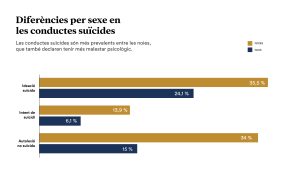
There are important differences regarding sex in relation to suicidal behaviours. As Regina Vila Badia has highlighted, "girls show more emotional distress and higher levels of anxiety and depression, as well as more impulsivity and feelings of loneliness compared to boys."
As can be seen in the following graph, both suicidal ideation and self-harm are between 10 and 19% higher in women than in men, and causes may include lower social support, lower resilience and lower life satisfaction. In addition, as the researchers indicate, women have experienced more sexual and emotional abuse, and feel more alone, factors that can be decisive in understanding these results.
The importance of prevention factors
There are many factors that contribute to suicidal behaviour, but according to the researchers, it is also very important to assess protective factors. Having social support, being resilient, being satisfied with what they do or having a stimulating educational environment can protect and promote the emotional well-being of young people.
In this sense, social support, understood as the perception of having a network of significant people who offer emotional, practical and communicative help, is key to reducing the risk of these behaviours.
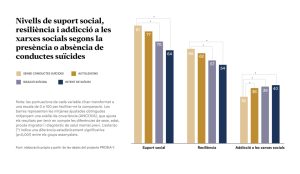
According to the study results Suicidal behaviours among young students in Catalonia: risk and protection factors, social support is significantly lower in young people who have had suicidal ideation or who have attempted suicide, 11 and 17% lower, respectively. The same happens with young people who show less resilience, understood as the ability to face difficult experiences and adapt positively. This resilience is 8 and 11% lower in people with suicidal thoughts and attempts, as observed in the following graph, compared to young people who have never presented suicidal behaviours.
Use of social networks: in the spotlight
One of the factors the study wanted to delve into was the influence of social networks on the emotional distress of young people.
According to the results, of the surveyed young people, only 4.1% consider that they make problematic use of social networks, 51.7% confirm that they watch or have watched pornography and 17.4% play gambling games, and all these behaviours can intensify their emotional distress. Furthermore, among young people who present suicidal behaviours (thoughts or attempts) an increase of between 6 and 8% is observed in the problematic use of social networks.
"Social networks are a great concern in relation to mental health problems. Even so, in our study we do not see that there is a direct relationship between their use and emotional distress, but rather the use of social networks reinforces this feeling," points out Regina Vila, one of the lead researchers, although the psychologist clarifies: "Once distress is present, the fact of using social networks in a problematic way can lead to an increase in this distress."
According to the researchers, to reduce the risk of suicidal behaviours it is key to strengthen social support, resilience and healthy use of social networks at school, at home and in the community. "What has surprised us most in the interviews is that the vast majority of people have not asked for help, even people who have made some attempt have not mentioned it, and this is very relevant», concludes Regina Vila Badia, researcher at Parc Sanitari Sant Joan de Déu and the SJD Research Institute. That is why it is so important that we learn to ask them so we can help and accompany them better.