

The Mental Investment Forum & Innovation Day of the TECSAM Network breaks attendance records
-
With over 150 attendees, MHIF-D is now a benchmark event connecting research, innovation and investment in mental health
-
Healthcare professionals, researchers and investors interested in impact investment in this area shared their experiences at the event
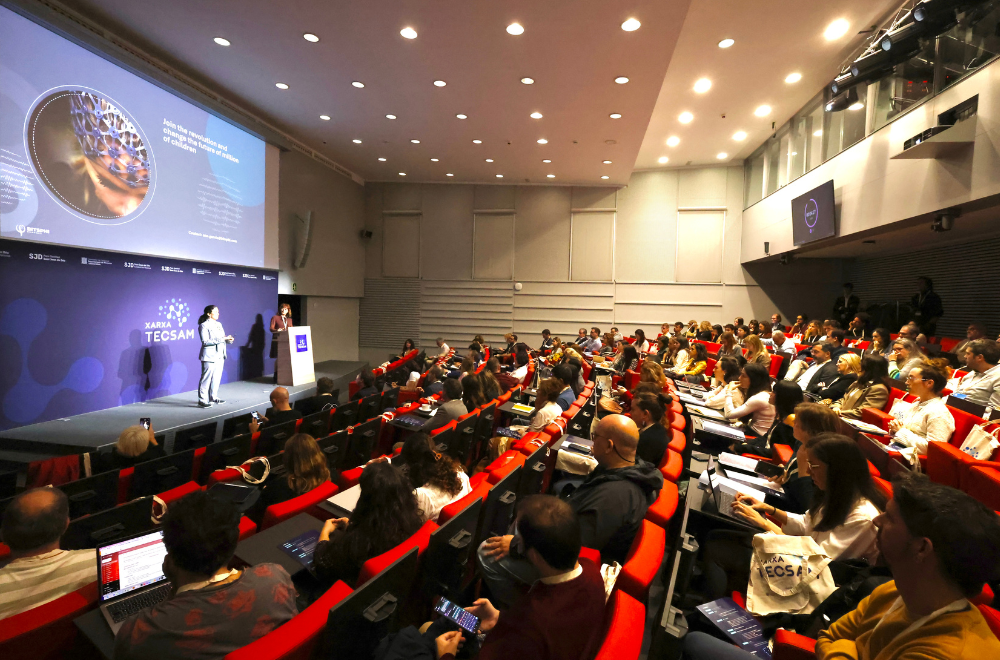
The second edition of the Investment Forum & Innovation Day (MHIF-D), organized by the TECSAM Network, brought together this Monday at the Pompeu Fabra University of Barcelona School of Management more than 150 participants: healthcare professionals, researchers and investors interested in impact investment in this area. MHIF-D is now well established as a benchmark event fostering innovation and knowledge transfer in mental health.
The opening session of the conference was presented by Dr Judit López, Head of Innovation at Parc Sanitari Sant Joan de Déu and promoter of the TECSAM Network, Dr Josep Maria Haro, Director of Teaching, Research and Innovation at Parc Sanitari Sant Joan de Déu and coordinator of the TECSAM Network, and Ms Lourdes Puigbarraca, the Government of Catalonia's Subdirector-General for Knowledge Transfer and Society. Dr Haro noted that the failure of the health system to address mental health problems means almost 50% of sufferers are not properly diagnosed, especially children and young people. Moreover, the drugs used to treat patients still need to improve greatly, as they have many side effects and are not effective for everyone. "That's why we are here today, to be able to improve mental health through innovation," he declared.
Brief presentations of five innovative start-ups
Attendees learned about the experience of five start-ups: Aima Beyond AI, Neuhera, 3Dthinks, Mential and Bitsphi Diagnosis. In this session, chaired by Gemma Hernández from the TECSAM Network, the five start-ups introduced their projects and presented innovative solutions that combine technology and science to address different challenges in mental health. Aima Beyond AI uses artificial intelligence to detect moods and offer support, while the Neuhera project creates neurotechnological devices to stimulate children's brains, and 3Dthinks applies advanced technology to detect stress more accurately. Other initiatives presented were Mential, which promotes emotional well-being with a personalised application, and Bitsphi Diagnosis, which carries out early digital diagnoses in mental health.
Success of the networking space and the TECSAM project exhibition
26 of the TECSAM Network’s 400-plus innovative solutions aimed at improving mental health were displayed in the networking space. The projects included advanced solutions, such as Avatar-VR, Andy's Mind, Econos and Muvity, which exemplify the transformative potential of research applied to this field.
The projects in this section were very diverse, ranging from digital solutions to assess and monitor disorders to virtual reality applications, artificial intelligence, personalised therapies and biomarkers. They included: FibroVR+, Presto, Beat, Picofon, Jepmen, Evimatic, Adaptea, EvalDepApps, Improva, PErmanens, ICOnnecta’t, Movere, Co-Elna, Mestral, Neurally, Permepsy, SMARTomics, Tobbstop, Biomarkers for Dementias, Flavii Therapeutics, Opade and Abcd. The projects’ creators were able to present their innovative technologies and solutions in a networking area with a stand or poster, with a view to making contact with investors and professionals, and strengthening collaboration with other key players in the mental health innovation ecosystem.
Round table on impact investment
The speakers at the roundtable on impact investment in mental health and well-being were Laia Pascual Ponce (Ship2B Ventures), Sara Leander-Pehrson (Heka VR), and Anna Bellmunt (Asabys Partners) and it was chaired by Cinta Díez (Invivo Partners). They pointed out that the pandemic has increased awareness and the budget dedicated to mental health, but there is still a lack of success stories and clinical validation is a challenge, especially in prevention and monitoring. To attract investment, it is necessary to establish a clear strategy, demonstrate efficiency and scalability, and adapt to each country's regulations and healthcare systems. It was also pointed out that investment in mental health is just beginning; hitherto an unexplored area, it is now a reality.
The event concluded with speeches by Judit López and by Nadal Bayà, head of the Knowledge Transfer Department at AGAUR, who highlighted the need to continue promoting collaboration between research, entrepreneurship and investment to continue developing innovative solutions in mental health. Bayà highlighted the importance of the TECSAM Network for the Catalan ecosystem and López invited attendees to continue working on innovation in mental health, inviting them to attend the next edition of the Mental Investment Forum & Innovation Day.
TECSAM reinforces its commitment to innovation and knowledge transfer
Since its creation in 2020, the TECSAM Network has worked to connect research, entrepreneurship and investment, in order to facilitate cooperation between healthcare centres, universities, technology companies and investors. The Network supports innovative projects in different areas of mental health, from early detection and the assessment of common disorders to digital therapeutic solutions and virtual reality applications in serious disorders. The TECSAM Network has again earned the support of the Government of Catalonia and will continue to receive funding to promote innovation and transfer, extend its areas of activity and strengthen its scientific and entrepreneurial community.
With these objectives, the Mental Investment Forum & Innovation Day has highlighted advances in technology applied to mental health by providing digital therapeutic solutions, artificial intelligence and platforms for the prevention and treatment of mental disorders.
The TECSAM network, promoted by Parc Sanitari Sant Joan de Déu
The TECSAM Network is coordinated by Parc Sanitari Sant Joan de Déu, within the Sant Joan de Déu Research Institute, in a project co-financed by the Department of Business and Knowledge's Secretariat for Universities and Research. The Network, made up of 63 research groups and 26 Catalan institutions, shares Parc Sanitari Sant Joan de Déu’s goal of helping to improve people's quality of life and facilitating access to treatment for people with mental health problems.