

The Arts in Health Day highlights the need to strengthen ties between the cultural and health sectors
-
Universal access to culture is an essential step for us to push forward this healthcare model that integrates art in therapeutic processes
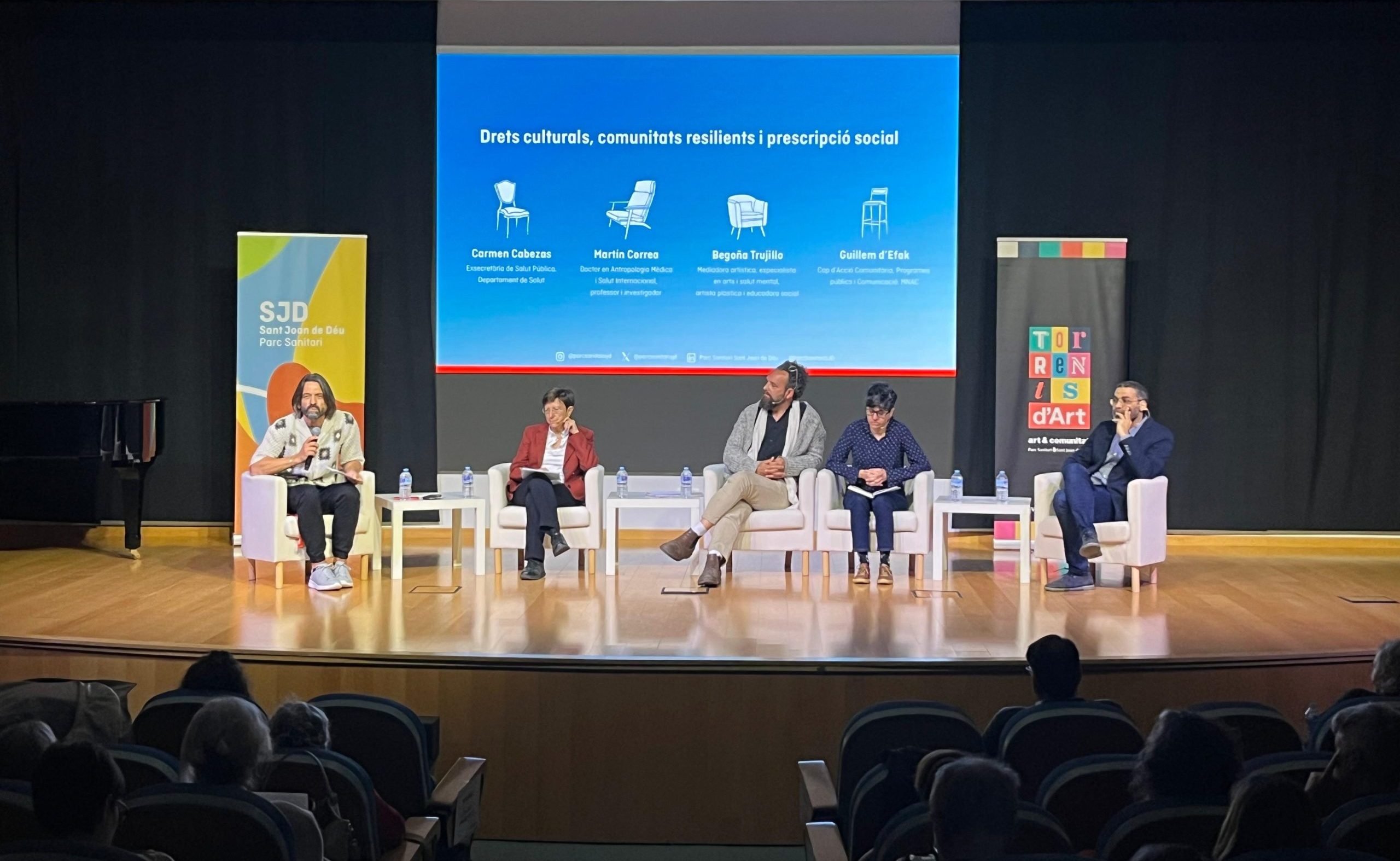
Strengthening links and generating lasting collaboration between the health and culture sectors is the great challenge of the Arts in Health programmes currently in progress in Catalonia. Despite the clear evidence of the benefits generated by the integration of art and culture in addressing certain disorders, the health and culture sectors still suffer from a lack of coordination, which must be resolved in the short term for the benefit of those being treated. This became evident in the opinions expressed today at the 7th Arts in Health Conference at Parc Sanitari Sant Joan de Déu, promoted by Torrents d'Art, as part of the Peripheries Arts, Mental Health and Community programme.
In recent years, significant progress has been made with the inclusion of social and cultural activities when prescribing healthcare. Through the Interdepartmental and Inter-sector Public Health Plan (PINSAP), the Ministry of Health has developed community resource maps that have allowed professionals to refer patients to social and cultural activities, such as reading clubs, visits to museums or art workshops. Carmen Cabezas, former Secretary of Public Health in the Government of Catalonia's Ministry of Health, pointed out that “in 2024 more than 30,000 social prescriptions were recorded in Catalonia. Nearly 3,000 people have been assessed and the results show that 64% report improved emotional well-being and 41% feel more supported, reducing loneliness and isolation."
The guests at the conference's two round tables all emphasised that this paradigm shift requires further action by the agents involved in the two sectors. There is a need for solid proposals that are embodied in an equitable programme of cultural activities which includes all artistic disciplines, reaches the whole region and is accessible to everyone, without exceptions, while resources are also needed to train professionals in this area. Arts in Health programmes must become an up-to-date and useful tool for healthcare professionals, allowing them to make the prescription of culture part of their clinical practice.
The right to culture as spectators and as creators
Universal access to culture was one of the main demands that emerged during the conference. Despite the progress made, we must continue working to make access to culture a reality for everyone, not only as audiences but also as creators. It's essential to promote the inclusion and professionalisation of all groups within the world of art. The work of the Escenaris Especials group in this area has been particularly valuable; for years they have fought to ensure that social diversity is also reflected on stage. Through workshops, training and performances, they have made it possible for people with functional diversity to participate actively in artistic creation and production, and have even staged events at large venues. “The goal of Escenaris Especials would be not to need to exist. This would mean that inclusion was already the norm. But it needs to be there, because it's only fair that these people can take part in artistic projects. And also so that society can enjoy more diverse audiences,” says its founder, Clàudia Cedó.
Torrents d'Arts, a pioneering Arts in Health programme at Parc Sanitari Sant Joan de Déu
In recent years, the potential of Arts in Health has been the subject of research by the World Health Organization (WHO), which has demonstrated how participation in the arts and access to a wide range of cultural opportunities can lead to improved health outcomes, healthier behaviours and increased well-being.
During the Conference, Guillem d'Efak, Head of Community Action, Public Programmes and Communication at the Museu Nacional d'Art de Catalunya, pointed out that it is very important to understand that, when we talk about Arts in Health, we are referring to a discipline based on five pillars: a clear health objective, an action group created jointly with professionals from the areas of healthcare and culture, active participation by recipients (who are the people being treated), rigorous evaluation focusing on objectives and on the generation or not of evidence. And lastly, publication and dissemination of the results.
Parc Sanitari Sant Joan de Déu makes an active contribution to this area through the Torrents d'Art programme, a pioneering initiative launched almost 15 years ago. Formed by an interdisciplinary team of healthcare, social and cultural professionals, Torrents d'Art defends the universal right to cultural creation, with special attention to groups in vulnerable situations.