

60% of treatment orders due to mental disorder defence are performed in prison
Sant Joan de Déu experts call for specialised care in external psychiatric units to ensure more effective and stigma-free recovery
• Professionals and people with personal experience point to prejudice and court inflexibility as the main barriers to reintegration
• Family support and guidance by specialised professionals are crucial for success
• Parc Sanitari Sant Joan de Déu experts call for an appropriate response to ensure effective treatment which respects the person cared for
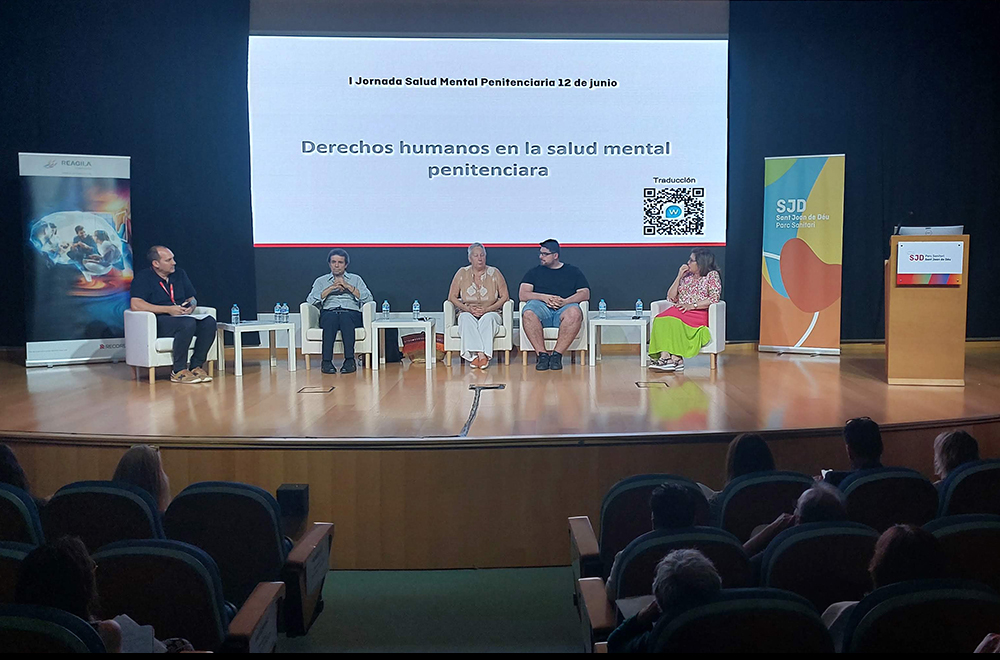
60% of sentences for crimes associated with mental disorders are served in prison psychiatric hospitals. Mental health professionals and experts think that the current system provides insufficient tools to ensure the recovery and reintegration into the community of the people affected. This is one of the main conclusions of the 1st Conference on Mental Health in the Prison Setting, which took place today at Parc Sanitari Sant Joan de Déu under the title Building bridges towards comprehensive care. The experts warn that the stigma and difficulty in transferring people with serious mental disorders to community resources hinders their recovery and reintegration and therefore call for specialised units outside the prison setting.
In Catalonia, 40% of the 8,000 incarcerated individuals required specialized mental health and addiction care during 2024. The conference has shown that even though it has a groundbreaking model, the Catalan prison and health system still has major difficulties in externalising people with serious mental disorders who have committed crimes in situations of mental disorder and do not understand the consequences of their behaviour. This situation entrenches a model that prioritises security over care, and is one of the main challenges for health policies, the penal model and human rights.
Aitor Eneko Olivé, Prison Mental Health Nursing manager at Parc Sanitari SJD, thinks that “people with mental disorders should receive specialised care, and when the risk diminishes, continue treatment in community resources. But the fact is that 60% of treatment orders are performed in prison psychiatric hospitals, which runs counter to the principles of recovery, deinstitutionalisation and dignity of care."
One of the main barriers to the reintegration of people who have committed a crime due to a mental disorder is the court requirement of zero risk when authorising transfer to community resources. However, this is a condition that professionals now consider clinically unfeasible. Even if they can show very low and controlled risk, the professionals think that this assessment alone is not enough. Indeed, as a result people with mental disorders stay in prison settings that keep them away from the most appropriate resources for their recovery, even though they are stabilised and ready to begin a reintegration process.
Stigma, an added sentence
People with mental disorders who are imprisoned are doubly penalised: because of their disorder and because of being held in custody. “When a person with a mental disorder commits a crime, they are no longer seen as someone in need of care and treatment but rather as a threat,” says Olivé. The account of Ismael Molina, who has been in the Penitentiary Psychiatric Hospitalisation Unit (UHPP), has described this reality. “When the health authorities think that you have already recovered, you can still be kept in for three more years because of the legal aspects. And when you get out, the social stigma is very strong. They are more afraid of me because of my mental disorder than because of the crime I committed," he says.
Molina's time at the Parc Sanitari Sant Joan de Déu UHPP has brought progress in breaking down institutional protocols which were more about serving the sentence than recovery. Molina struggled, for example, to gain access to a computer and enrol at university. It is crucial for him to plan his life before release and most importantly to have family support and professional guidance from the mental health unit. Today, with a normalised life and a professional qualification, Molina takes part in research on stigma and whenever asked shares his experience, just as he did at the UHPP, as an expert patient to help new inmates settle into the unit. “It's what I would have liked to have when I arrived,” he comments.
A commitment to dignity and the community
For decades, Parc Sanitari Sant Joan de Déu has been committed to a model centred on the person and recovery in contact with the community. The professionals are calling for this issue to be a priority on the political and social agenda. "We are facing an emergency that warrants visibility and action," say the professionals who are in daily contact with people in prison mental health care units.
Accordingly, the Parc Sanitari SJD advocates setting up specialised services in the civil setting where existing strategies and techniques are implemented to deliver recovery projects by assessing risk without fear getting in the way of community care and reintegration coupled with appropriate restraining measures designed to end the cycle of exclusion. Countries such as France and the United Kingdom have already rolled out intermediate high-security community units which combine specialisation with stigma-free reintegration.
With two psychiatric hospital units in Brians 1 and 2 and outpatient care programmes, Parc Sanitari Sant Joan de Déu is one of the leaders in prison mental health in Catalonia. It employs 250 professionals to ensure that people who have committed a crime due to a mental disorder have access to treatment free of stigma and with the same opportunities for reintegration as those receiving care in the community.