

Advanced therapies, personalisation and regenerative medicine; the future of complex wounds
Autologous growth factors, cytokine-rich serum and micrografts are three of the most innovative and effective treatments for accelerating wound healing in highly complex cases
Driving research applied to clinical practice and investing in continuing professional development are two strategic priorities for improving specialist nursing practice in complex wounds
The 1st Wounds 360 Conference, co-hosted by Parc Sanitari SJD, the SJD Teaching Campus and the Catalan Health Institute (ICS) el Baix Llobregat Primary and Community Care Management Unit, brought together more than 200 people
Complex wounds, such as pressure injuries, diabetic wounds and chronic vascular lesions, are a significant challenge for healthcare teams. However, research in this field has recently shifted towards treatment models harnessing biotechnology and regenerative medicine designed to expedite healing, reduce pain and complications and personalise therapy for each individual patient.
Innovation in chronic wound care, which has seen sustained growth in recent years, was one of the core topics at the 1st Wounds 360 Conference held today at Parc Sanitari SJD and the SJD Teaching Campus under the tagline Experience, Knowledge and Innovation. During the conference, discussions addressed the efficacy of Plasma Rich in Growth Factors (PRGF) methods, as well as dermo-epidermal micrografts. Specifically, participants shared experiences of using this technique in primary care settings as an innovative solution for hard-to-heal wounds. “There are patients who have been living with a chronic, non-healing wound and who thanks to the micrograft technique have finally achieved complete healing,” says Miguel Ángel Díaz, coordinator of the Chronic and Complex Wounds Unit. “Following the good results achieved, this technique has now been rolled out across the entire Southern Metropolitan and el Penedès Primary Care network.”
As for Autologous Cytokine-Rich Serum (ACRS), an emerging treatment, the Complex Wounds Unit at Parc Sanitari SJD shared its first-hand experience in treating diabetic foot ulcers. “It's a treatment which can have a major impact on this type of injury by fostering the healing process," points out Cristina Jiménez, a specialist nurse and member of the Complex Wounds Unit at Parc Sanitari SJD. "By shortening healing time, we also lessen the likelihood of potential complications such as infections, which in some cases might be very serious."
Co-hosted by Parc Sanitari SJD, the SJD Teaching Campus and the ICS's el Baix Llobregat Primary and Community Care Management Unit, this event has cemented its position as a new preeminent discussion and training venue for professionals specialising in addressing complex wounds, drawing together the three key areas of primary care, hospital settings and university education.
Investing in continuing professional development: upskilling to move forward
Continuing professional development in complex wounds is also a strategic need for primary and community care nurses. These injuries, which tend to become complicated, have a significant clinical, social and economic impact and mean that practitioners with specific skills need to continue their professional development throughout their careers to ensure efficient care consistent with the latest scientific evidence.
The field is seeing substantial growth in the range of specialist programmes, conferences and advanced training courses available, reflecting this requirement for continuous learning to address new healthcare challenges.
The conference also looked at university and postgraduate nursing education, pointing out the need to revamp academic curricula for healthcare professionals and include a module on chronic wounds in the nursing degree syllabus. “The idea is to beef up training specifically on preventing, diagnosing and treating wounds in university degrees, and also in vocational education and training for nursing assistants, to successfully tackle new patient care and safety issues,” noted Dr Lorena Molina, manager of the SJD Teaching Campus.
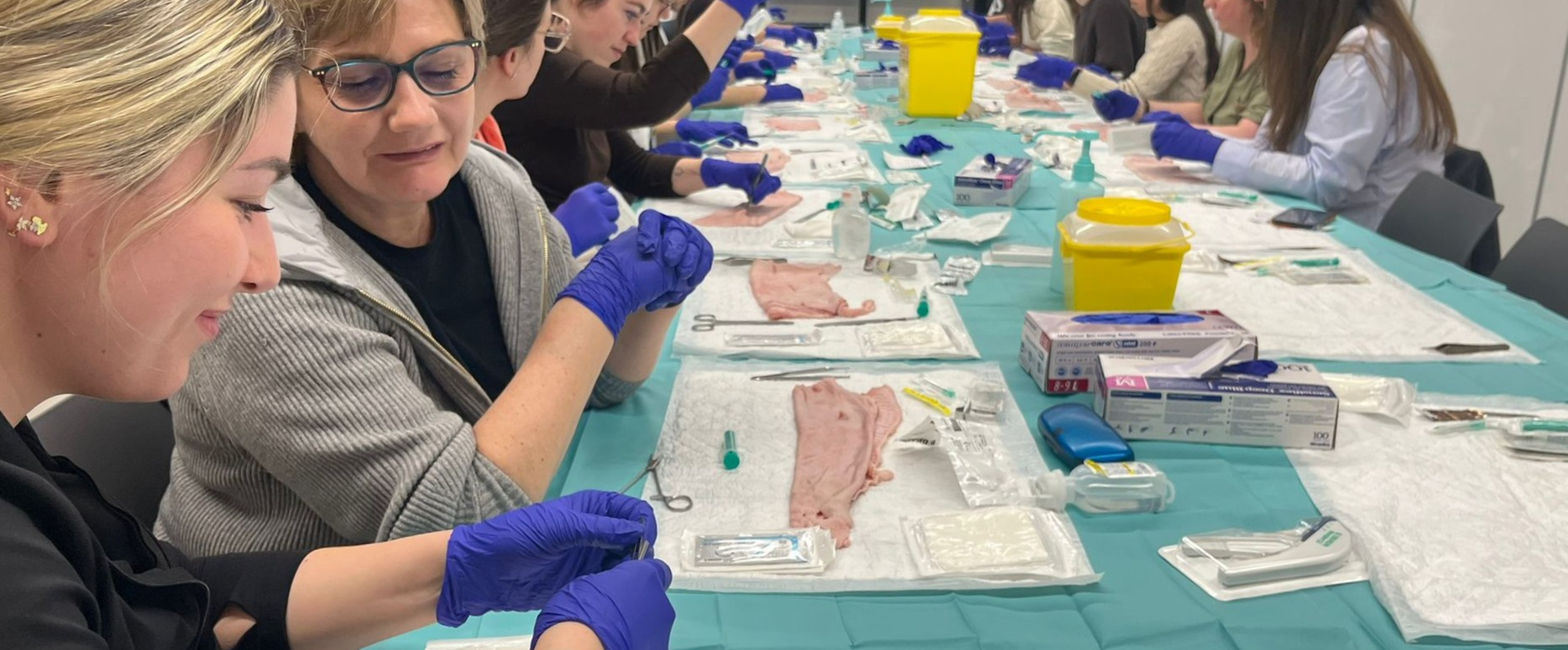
As part of this work strand, the conference featured six training workshops which covered key areas of the specialism including preventing dependency-related skin injuries; therapeutic compression; diagnostic ultrasound in lower limb wounds. dermo-epidermal micrografts. sutures and diagnosis, prevention, and treatment of the diabetic foot.
Applied research with a nursing focus
Driving clinical research applied to healthcare practice is also crucial in chronic wounds. These studies yield new scientific evidence-based treatments delivering personalised solutions. Examples include research into the microbiome in diabetic foot, using sevoflurane for local treatment of painful wounds and the effectiveness of cytokine-rich serum in treating diabetic foot.
Excellence, progress and innovation in wound care are being achieved in both primary care and hospital settings, indicative of a seamless approach across all levels of care which complement their service portfolios and bolster coordination between teams to ensure truly integrated care throughout the entire process.